CLARIN 2026
A multi-scale, traceable analysis of Slovenian parliamentary discourse, 1992–2022
Every claim in this thesis can be walked back to the speeches it rests on, on CLARIN.SI infrastructure, end to end.

- RQ1 · Macro What the Assembly discusses 213 372 speeches → 398 topics
- RQ2 · Meso How the contested past is mobilised, traced term by term 398 topics → one term → 2 059 lines
- RQ3 · Micro How accountability is enacted under pressure Interpellations → feature rates → extremes read in full
Read the abstractAbout 500 words
This PhD project presents a corpus read at three levels, in a chain in which every step is saved and re-runnable; topic → term list → CQL query → concordance lines → close-read speech. The approach is from distant to close (macro → meso → micro), using a “glass box” approach.
The corpus used is siParl 4.0 (Pančur et al. 2024) from the CLARIN.SI repository, more specifically, its distribution with full linguistic annotation (Ljubešić & Dobrovoljc 2019). The research focuses only on plenary speeches, and chair procedural turns are excluded, netting a total of 213 372 speeches in eight terms and 30 years. The pipeline also relies on the CLARIN.SI concordancer, for corpus analysis, and two CLASSLA resources: the Slovenian Language Technologies Overview (for embedding model candidates) and the ParlaCAP classifier (Kuzman Pungeršek et al. 2026).
The broadest, macro scale (distant reading) employs one BERTopic model over the 213 372 speeches. The default encoder reads a median 29 % of a speech (due to truncation). Five multilingual encoders were compared, each reading whole speeches as raw text, and using a lemma POS filter for the topic labels. The chosen model was Qwen3-Embedding-0.6B (runnable on a free-tier Colab T4), and the production run had a minimum cluster size of 75, where every policy area above 1 % of speeches has at least four topics (set against ParlaCAP labels).
RQ1 asks what parliament discusses, how its attention shifts, and how small, niche parties engage relative to mainstream ones.
The meso (corpus) scale picks terms from the topic model strings and runs a frequency and collocation analysis on a specific issue emerging from RQ1, selected from domain knowledge (in our case ‘war’). Collocation parameters are set: logDice ≥ 7 strong, window ±5. From the results, specific cases are chosen for further investigation, in our case “grobišče” (‘war grave’), logDice 8.92 (topic T181). A frequency matrix is created to have a broader view of emerging patterns. CQL queries allowed to map the 2 059 plenary hits into “prompted” (1 613 on sitting days of five war-graves acts and related debates) and “unprompted” (446).
At this scale, the salience and dynamics of ideological discourse are compared to scandals (persistence vs spike and fade).
The micro scale (close reading) builds on scandals, focusing on interpellation debates, which call ministers to account but rarely end in dismissal (Pegan & Krašovec 2021). An interpellation subcorpus will be created (enriching the main corpus) and specific adversarial linguistic features will be measured (deontic modality, negation, address forms and blame pronouns) over every interpellation speech, and each feature’s extremes read in full. These speeches’ topic labels tie them back to the macro scale; topic dispersion shows whether a debate stays on its policy area.
Upon completion, corpus corrections and various user-based improvement suggestions will be submitted to the siParl authors. The embeddings, topic modeling pipeline, ParlaCAP labels back to 1990, the interpellation metadata, and other deliverables will be deposited in CLARIN.SI, with documentation for re-running it on ParlaMint corpora.
siParl; parliamentary discourse; topic modeling; collocation; critical discourse analysis; traceability
References- Kuzman Pungeršek, T., Rupnik, P., Širinić, D., & Ljubešić, N. (2026). Supercharging agenda setting research: The ParlaCAP dataset of 28 European parliaments and a scalable multilingual LLM-based classification. arXiv:2602.16516.
- Ljubešić, N., & Dobrovoljc, K. (2019). What does neural bring? Analysing improvements in morphosyntactic annotation and lemmatisation of Slovenian, Croatian and Serbian. In Proceedings of the 7th Workshop on Balto-Slavic Natural Language Processing (pp. 29–34). Association for Computational Linguistics. https://doi.org/10.18653/v1/W19-3704
- Pančur, A., Meden, K., Erjavec, T., Ojsteršek, M., Šorn, M., & Blaj Hribar, N. (2024). Slovenian parliamentary corpus (1990–2022) siParl 4.0. Slovenian language resource repository CLARIN.SI. http://hdl.handle.net/11356/1936
- Pegan, A., & Krašovec, A. (2021). Slovenian Parliament. PSA Parliaments briefing. https://psaparliaments.org/wp-content/uploads/2021/03/Slovenia-1.pdf
Cite the posterAPA · BibTeX
Bordon, D. (2026, September 30). A multi-scale, traceable analysis of Slovenian parliamentary discourse, 1992–2022 [Poster presentation]. CLARIN Annual Conference 2026, Brighton, United Kingdom. https://davidbordon.com/academia@misc{bordon2026clarin,
author = {Bordon, David},
title = {A multi-scale, traceable analysis of {S}lovenian
parliamentary discourse, 1992--2022},
howpublished = {Poster, CLARIN Annual Conference 2026,
PhD student session, Brighton, United Kingdom},
month = sep,
year = {2026},
url = {https://davidbordon.com/academia}
}Current work
PhD in Digital Linguistics
Nov 2022 – ongoing
Corpus Discourse Analysis in the National Assembly of the Republic of Slovenia. Mixed-methods work combining critical discourse analysis with corpus linguistics and computational sociolinguistics, asking how power moves through the language of a debate.
Slovene consortium PhD student representative at the CLARIN 2026 conference.
Assistant Researcher
Faculty of Arts · May 2021 – present
Doctoral research alongside teaching, language-resource work and academic multimedia production – podcasts, conference recordings and the hybrid streams that let a conference happen in two places at once.
Earlier
DSDE · to 2022
On the DSDE project (Development of Slovene in a Digital Environment) before the doctorate: language tool development, corpus and database construction, copyright contracts, and administration of the project's web portal.
Publications
Edited volumes
-
2026
Eskevich, M., Vandeghinste, V., & Bordon, D. (Eds.). ParlaCLARIN V: Workshop on Interoperability, Multilinguality, and Multimodality in Parliamentary Corpora. LREC 2026 proceedings, Palma de Mallorca. ELRA.
-
2024
ParlaCLARIN IV: Workshop on Creating, Analysing, and Increasing Accessibility of Parliamentary Corpora. LREC-COLING 2024 proceedings, Torino. ELRA.
Articles and chapters
-
2024
Popič, D., Bordon, D., Franza, J., & Bezgovšek, L. Jezikovna orodja za slovenščino v Italiji: Jezikovni asistent Loris 1.1. In M. Grgič (Ed.), Slovenščina v Italiji (pp. 167–194). Založba Univerze v Ljubljani.
-
2023
Bordon, D. Do you Speak Neuralese? How People Comprehend the Modern Language of Machine Translation Engines – expanded article. Slovenščina 2.0, 11(1), 138–159.
Conference papers
-
2022
Bordon, D. Do you Speak Neuralese? How People Comprehend the Modern Language of Machine Translation Engines. In D. Fišer & T. Erjavec (Eds.), Proceedings of the Conference on Language Technologies and Digital Humanities (pp. 286–291). Ljubljana.
Best student paper
Conference presentations
-
2026
Bordon, D. A Multi-Scale, Traceable Analysis of Slovenian Parliamentary Discourse, 1992–2022 [poster]. CLARIN Annual Conference 2026, PhD student session, Brighton.
-
2025
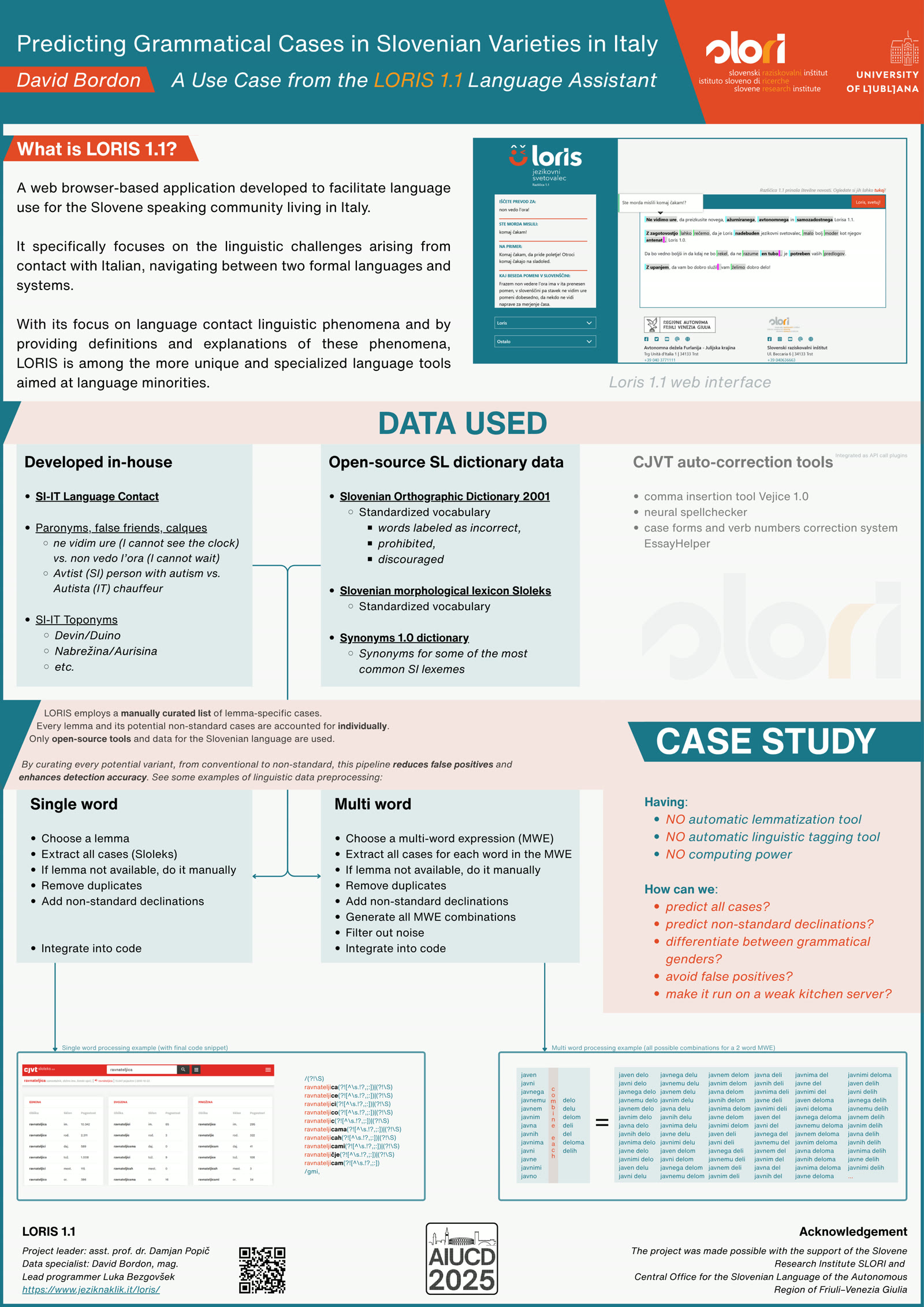
Bordon, D. Predicting Grammatical Cases in Slovenian Varieties in Italy: A Use Case from the LORIS 1.1 Language Assistant [poster]. AIUCD 2025, University of Verona.
Gigliozzi Prize for best poster
-
2025
Bordon, D. The Historical Discourse of National Trauma. Helsinki Conference on Emotions, Populism and Polarisation (HEPP5), University of Helsinki.
-
2025
Bordon, D. Linking External Events to Discourse Shifts in Slovenian Parliamentary Debates. Corpus Linguistics 2025, Aston University, Birmingham.
-
2025
Bordon, D. Discourse Analysis of Fringe Parties in Slovenian Parliamentary Debates. "From the extremes to the centre and back again?", University of Navarra, Pamplona.
-
2025
Bordon, D. Identifying and Categorizing Topics in Slovenian Parliamentary Debates. New Perspectives in Humanities and Social Sciences, University of Ljubljana.
-
2024
Bordon, D., Gorjanc, V., & Anastasi, S. Narratives of a Nation: The Discourse of National Unity and Division in the Slovene Parliament. Sociolinguistic Symposium 25, Curtin University, Perth.
Language resources
-
2023
Popič, D., Bordon, D., & Bezgovšek, L. Loris 1.0, application and web interface. Slovenski raziskovalni inštitut (SLORI).
Conference reports
-
2025
Bordon, D. Konferenca Digitalna humanistika ADHO DH 2025, Lizbona. Slovenščina 2.0, 13(1), 138–146.
-
2023
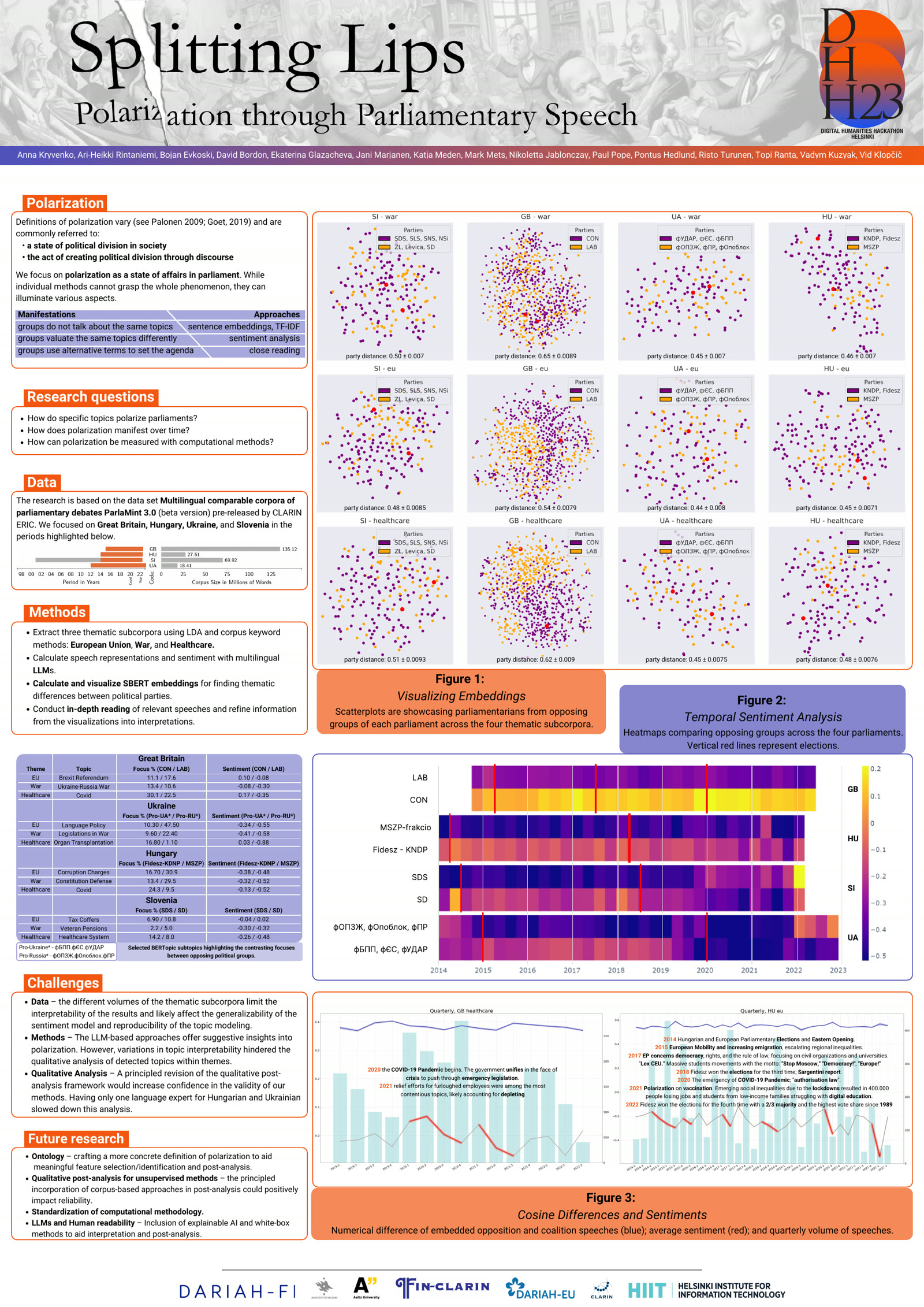
Bordon, D. DHH23 – Helsinki Digital Humanities Hackathon 2023. Slovenščina 2.0, 11(2), 92–101.
-
2022
Bordon, D. Konferenca Jezikovne tehnologije in digitalna humanistika 2022. Slovenščina 2.0, 10(1), 131–135.
Awards
- 2025 Gigliozzi Prize for best poster, AIUCD 2025, Verona
- 2023 Best Poster Design, Helsinki Digital Humanities Hackathon
- 2022 Best student paper, JT-DH 2022, Ljubljana
Chairing and organisation
- 2026 ParlaCLARIN V – chair, organiser and editor. LREC 2026, Palma de Mallorca
- 2024 ParlaCLARIN IV – chair, organiser and editor. LREC-COLING 2024, Torino
- 2024 Student Section, JT-DH 2024 – chair
Teaching and training
Teaching
Seminars and lectures at the Faculty of Arts on computer-assisted translation, machine translation and linguistic data processing, as well as photography, audio and video production workflows. I supervise student podcast production in digital humanities.
Invited workshop
Navigating the Digital Hall of Mirrors – AI as a Tool, Not a Distraction. Sommerkolleg Bovec, 12–25 July 2026.
An interactive workshop on how AI systems handle language across text, image, audio and analogue material, and what happens to cultures with little digital footprint when language becomes training data.
Guest lectures and workshops
- Oct 2026 University of Trieste – the next set of guest lectures on machine translation and AI workflows
- Feb 2026 SLORI – machine translation and AI workflows, an online workshop in four two-hour sessions
- Nov 2025 · Jan 2026 University of Trieste – guest lectures on machine translation and AI workflows
Research visits
- Feb – Mar 2024 University of Torino, Department of Humanities. One month of doctoral course work in digital humanities.
- May 2024 CAPPE, University of Brighton. One month in political theory – Mouffe, Laclau – and preparation of the dissertation proposal.
Summer schools
- Jul 2025 Birmingham Summer School in Corpus Linguistics – attended and presented
- Jun 2025 Lancaster Summer School in Corpus Linguistics
- 2024 Digital Humanities and Digital Communication, University of Modena and Reggio Emilia – poster presenter
- 2024 Misinformation, Disinformation and Hate Speech, UNICRI & SIOI, Rome
- 2023 Helsinki Digital Humanities Hackathon
Curriculum vitae
The full record – education, experience, the complete publication list, mobility and training – as a document.
Download CV (PDF) →